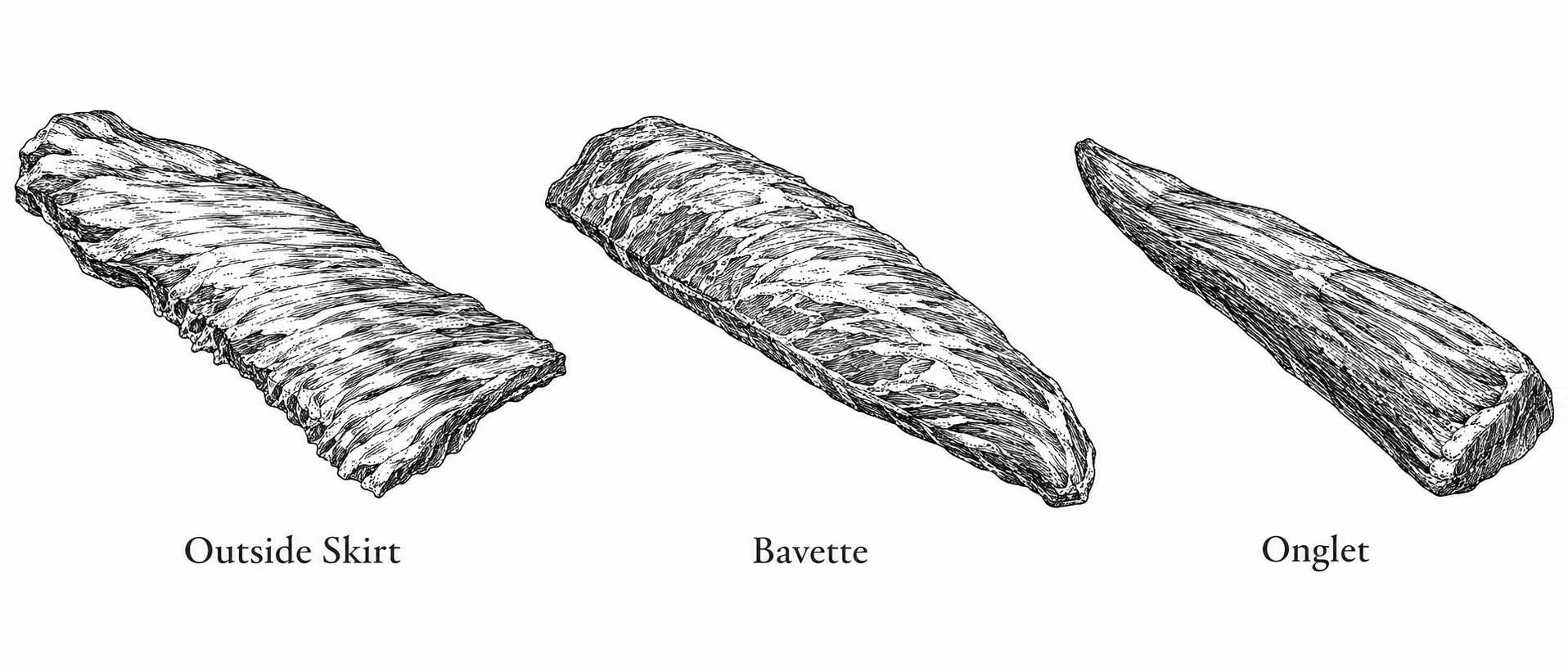
Outside skirt, bavette, onglet and beef skirt are all richly flavoured cuts with a noticeable grain, but they are not interchangeable.
They come from different muscles, vary in thickness and tenderness, and suit slightly different styles of cooking.
The right choice depends on whether you want a quick steak supper, a larger cut for sharing, something to cook over charcoal or beef for a traditional slow-cooked dish.
| Cut | Texture and flavour | Best cooking method | Best for |
|---|---|---|---|
| Outside skirt | Loose grain and exceptionally deep beef flavour | Very hot and fast | Steak suppers, fajitas and barbecue |
| Bavette steaks | Open texture, tender when carved correctly and richly flavoured | Pan-frying or grilling | Everyday steak meals and marinades |
| Whole bavette | The same open texture in a larger sharing cut | Barbecue or cast-iron cooking | Sharing platters and feeding a group |
| Onglet | Thicker, tender and intensely savoury | High-heat cooking, served pink | A distinctive, steak-like experience |
| Beef skirt | Robust grain with strong beef flavour | Fast grilling or long, slow cooking | Pasties, pies, braises and grilling |
Outside skirt is a long, relatively thin muscle from the diaphragm.
It has a loose, visible grain and one of the strongest beef flavours of any quick-cooking steak. It develops a good crust very quickly and works particularly well in a hot cast-iron pan or over direct barbecue heat.
Our outside skirt is cut into two generous steaks, making it a convenient choice for two people.
Choose outside skirt when you want:
Bring the steaks towards room temperature and pat them dry.
Season well, then cook over very high heat for a short time. Depending on their thickness, they may need only two or three minutes on each side.
Rest for around five minutes before carving.
The muscle fibres are long and easy to see. Slice thinly across those fibres rather than following them. This shortens the grain and gives a more tender result.
Best choice for: Maximum flavour and a quick steak supper.
Recipe:
Outside Skirt Steak and Mushroom Skillet with Parsley
Shop:
Outside Skirt Steak – 2 × 284g
Bavette comes from the flank area and is sometimes described as thin flank.
It is a broad, relatively flat steak with an open texture. This makes it particularly good at taking on marinades made with garlic, herbs, citrus, vinegar or soy sauce.
Bavette has plenty of beef flavour but is often a little milder and more approachable than outside skirt or onglet.
We offer bavette as individual steaks and as a larger whole cut.
Choose bavette steaks when you want:
Cook bavette quickly over high heat until browned on the outside and still pink in the centre.
Rest before carving, then slice thinly across the grain.
Avoid taking bavette much beyond medium. As with outside skirt, the fibres become firmer as the meat cooks further.
Best choice for: A versatile and approachable everyday steak.
Cooking guide:
How to Cook Bavette Steak
Whole bavette has the same open texture and rich flavour as individual bavette steaks but is supplied as a larger piece.
It makes an excellent sharing cut for a barbecue or relaxed meal. Cook it whole, allow it to rest and carve it into thin slices at the table.
A whole bavette will naturally vary in thickness. The thinner end will cook a little more quickly, while the thickest section can remain pink. This can be helpful when serving several people with different preferences.
Choose a whole bavette when you want:
Season generously and brown the beef over direct heat.
If necessary, move it to a cooler part of the barbecue or reduce the heat beneath the pan while the thickest part finishes cooking.
Rest it thoroughly, then carve thinly across the grain.
Best choice for: Cooking over fire and sharing at the table.
Shop:
Whole Bavette – approximately 1.2kg
Onglet is also known as hanger steak or body skirt.
It is found close to the diaphragm but is thicker and more steak-like than outside skirt. It has a deep savoury flavour that is sometimes described as slightly mineral.
There is only one onglet on each animal, making it a relatively scarce cut.
When carefully prepared and cooked, onglet is tender enough to serve in the same way as a conventional steak.
Choose onglet when you want:
Cook onglet over high heat until a strong crust develops.
It is best served rare or medium-rare. Taking it much beyond medium can cause the fibres to tighten and become noticeably firmer.
Allow it to rest before carving across the grain.
Best choice for: A distinctive steak supper with deep, savoury flavour.
Cooking guide:
How to Cook Onglet or Hanger Steak
Beef skirt is usually supplied as a larger piece rather than as an individual steak.
It has a pronounced grain and robust flavour. What makes it particularly useful is that it can be treated in two different ways.
It can be cooked quickly over fierce heat and served pink, or it can be cooked slowly in liquid until the fibres become tender.
Skirt has traditionally been used for Cornish pasties because its juices help create flavour and moisture as the pasty cooks.
Choose beef skirt when you want:
For steak-style cooking, use high heat and a short cooking time. Rest well and slice thinly across the grain.
For pies, casseroles or braises, cut the skirt into suitable pieces and cook gently in stock, wine or sauce until tender.
Do not use a medium-length cooking method. Skirt is best either cooked very quickly or given enough time for its fibres to soften completely.
Best choice for: Traditional dishes and maximum cooking versatility.
Cooking guide:
A Guide to Cooking with Beef Skirt
Outside skirt and onglet offer the most intense flavour.
Outside skirt has a bold, direct beefiness and plenty of charred surface when cooked quickly.
Onglet is equally rich but has a deeper, slightly mineral character and a thicker, more traditional steak texture.
Bavette is still richly flavoured but is usually the most approachable of the three quick-cooking cuts.
Traditional skirt has robust flavour but is often used as part of a larger dish rather than served alone as a steak.
Onglet is generally the most naturally tender and steak-like option when properly trimmed and cooked rare or medium-rare.
Bavette can also be very tender, provided it is not overcooked and is sliced correctly.
Outside skirt has a looser, more pronounced texture. It remains enjoyable and tender when cooked briefly and carved thinly across the grain.
Traditional skirt benefits most from careful carving when grilled or from long, slow cooking.
Choose outside skirt for a fast barbecue steak with maximum char and beef flavour.
Choose whole bavette when cooking for several people and you want a sharing cut to carve at the table.
Choose onglet when you want a thicker steak that can develop a strong crust while remaining pink inside.
Traditional skirt can also be grilled, but it is particularly useful when you want the option of using it for another dish.
Bavette and outside skirt both have an open grain that works well with marinades.
Bavette is particularly versatile and suits:
Outside skirt stands up well to stronger flavours but needs little more than salt when cooked over charcoal.
Onglet has enough natural character that simple seasoning is often the better choice.
Choose outside skirt for a quick steak supper with the deepest beef flavour.
Choose bavette steaks for a versatile, approachable steak that works with many different seasonings and marinades.
Choose whole bavette for a barbecue or sharing meal.
Choose onglet when you want the thickest, most distinctive and most steak-like cut.
Choose traditional beef skirt for pies, pasties, casseroles or a cut that can be cooked either very quickly or very slowly.
Whichever cut you choose, use plenty of heat for fast cooking, allow the beef to rest and always check the direction of the grain before carving.
No. Both are long-grained, richly flavoured cuts, but outside skirt comes from the diaphragm while bavette is associated with the flank. Outside skirt is generally more intensely flavoured, while bavette is broader and particularly well suited to marinades.
Onglet is sometimes called body skirt or hanger steak. It is positioned close to the diaphragm but is thicker and more steak-like than outside skirt.
Slicing across the grain shortens the long muscle fibres. This makes each slice easier to chew and produces a more tender eating experience.
Traditional beef skirt works very well in slow-cooked dishes. Outside skirt, bavette and onglet are usually better cooked quickly and served pink.
Outside skirt and bavette are both excellent choices. Outside skirt provides the strongest flavour, while bavette has a broad shape and open texture that absorbs marinades well.
Outside skirt, bavette and onglet all work well. Cook the beef pink, rest it thoroughly and carve it into thin slices across the grain before adding it to the sandwich.