
Regenuary was founded as a campaign to promote regenerative farming — an approach to agriculture that aims to improve land rather than simply extract from it.
Key principles include:
Building healthy, living soil
Encouraging biodiversity above and below ground
Using animals as part of natural cycles rather than isolating them from the land
Reducing reliance on synthetic inputs
Focusing on long-term productivity rather than short-term yield
This is not a rigid rulebook. It is a direction of travel, rooted in observation and adaptation, rather than blanket prescriptions.
 Regenerative Farming and Livestock: Clearing the Air
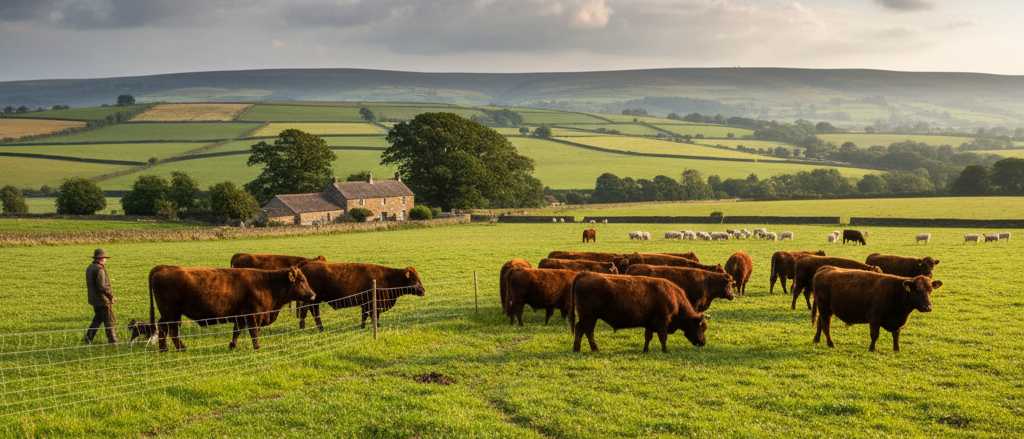
Livestock often sits uncomfortably in modern food debates, but regenerative systems make an important distinction between industrial livestock production and properly managed grazing animals.
In well-run pasture systems:
Cattle and sheep stimulate grass growth through grazing
Hooves help incorporate organic matter into the soil
Manure feeds soil biology rather than polluting waterways
Permanent pasture locks carbon into the ground
Marginal land unsuitable for crops is put to good use
This is particularly relevant in upland and mixed farming regions like North Yorkshire, where grass grows reliably but crops often do not.
One of the reasons Grid Iron places so much emphasis on native breeds is that they are well suited to regenerative systems.
Native cattle and sheep:
Thrive on grass rather than high-input feed
Cope better with weather extremes
Grow at a natural pace, allowing time for proper fat development
Fit into mixed farms alongside arable crops, hedgerows and woodland
These breeds evolved alongside British landscapes. Used thoughtfully, they support the land rather than working against it.
Grid Iron is not a campaigning organisation, but the choices behind the business line up closely with Regenuary thinking.
Grid Iron works with known farms in North Yorkshire, not anonymous supply chains. That closeness allows conversations about grazing, finishing, seasonality and welfare — things that matter in regenerative systems.
Regenerative farming values balance, and that extends to how animals are used. Promoting a wide range of cuts helps avoid pressure to overproduce a narrow set of “popular” steaks.
Whether it is slower-grown animals, proper hanging, or traditional curing, time is treated as essential rather than wasteful. Regenerative farming works on the same principle — soil and ecosystems improve gradually, not overnight.
Not every farm supplying Grid Iron would label itself “regenerative”, and that honesty matters. Farming exists on a spectrum. Supporting farmers who are moving in the right direction is often more constructive than chasing purity.
One of the quiet strengths of Regenuary is that it is not meant to end on the 31st of January.
For customers, that might look like:
Eating slightly less meat, but buying better meat
Valuing grass-fed and pasture-based systems
Accepting natural variation in size, fat cover and availability
Cooking with seasonality in mind
Understanding that good farming costs more because it gives more back
For businesses like Grid Iron, it means continuing to prioritise farming relationships, native breeds and honest communication — even when those choices are not the easiest commercially.
Regenuary is sometimes portrayed as radical, but in many ways it reflects how farming worked before cheap inputs and globalised supply chains distorted incentives.
Mixed farms. Grazing livestock. Hedges. Rotation. Patience.
In that sense, Regenuary is not about reinventing food systems from scratch. It is about reconnecting modern food businesses and customers with approaches that already make sense — especially in places like North Yorkshire.
Grid Iron’s role is simply to sit between farm and table, making those systems viable by giving farmers a fair return and customers food they can trust.
Not a slogan. Just steady, grounded progress — one animal, one farm, one decision at a time.