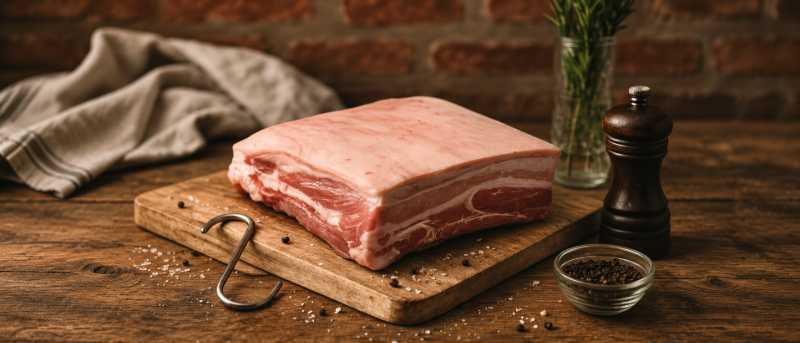
Skin on and ribs still attached, bone-in pork belly makes a generous slow roast. Here is why the cut works, how to get crisp crackling and how to carve it.
Grid Iron Gourmet / From the Butchery
Bone-in belly pork is one of those cuts that asks very little of the cook. Give it time, keep the skin dry and let the layers of meat and fat do their work. The result is soft, rich pork beneath a sheet of crisp crackling.
At Grid Iron, our rare-breed belly pork comes as a flat joint with the rind and rib bones left in place. It is quite different from a boned and rolled joint, and it is worth knowing what to expect before you put it in the oven.
Pork belly comes from the underside of the pig. It contains alternating layers of meat and fat, with the ribs running along part of the cut. With our bone-in joint, those ribs remain attached. The rind is left on, ready for crackling.
It is not the same as a rack of belly ribs sold on its own. Here you have the full roasting joint, with the belly meat, fat, skin and bones together.
The bones support the joint as it cooks and offer some protection from the direct heat of the roasting tin. They also give you a few richly roasted ribs to enjoy after carving. The real secret to succulent belly, though, is its natural fat and a slow, steady cook – not the bone alone.
Our pork comes from traditional breeds reared on farms in North Yorkshire. These slower-growing pigs develop a natural covering of fat, which is especially useful in a belly joint. As it cooks, the fat softens and renders, giving the meat its characteristic richness.
We normally allow our pork to hang for around seven days where practical. That helps develop its eating quality. The amount of fat and exact shape will vary between animals, which is part of working with traditional breeds.
1. Dry the rind. For the best crackling, take the joint out of its packaging the day before cooking. Pat it dry and leave it uncovered on a tray in the fridge, away from other foods. Score the rind if needed, cutting through the skin but not deeply into the meat.
2. Start with a hot oven. Pat the skin dry once more and season it with salt. Place the belly skin-side up on a rack or on a bed of sliced onions in a roasting tin. Heat the oven to about 220°C conventional / 200°C fan. Roast for roughly 25-35 minutes, watching for the rind to bubble rather than burn.
3. Turn the heat down. Reduce to about 160°C conventional / 140°C fan. Allow roughly another 2-3 hours for a joint around 2-2.5kg, checking earlier if it is thin. Larger joints may take longer. The meat is ready when a skewer goes into the thickest part easily and the layers feel soft. Timings are a guide, not a guarantee.
4. Check it properly. Probe the thickest part of the meat without touching a rib. Pork must be thoroughly cooked: a core temperature of 70°C held for two minutes is a recognised safe combination. Belly is usually cooked further than this for the tender texture people expect.
5. Rest and carve. Rest for 20-30 minutes. Do not wrap the crackling tightly in foil or it may soften.
It usually comes down to moisture. Keep stock, cider and roasting juices below the skin, not over it. Do not baste the rind. If the pork is tender but the skin still needs work, cut the crackling away and return that piece to a hot oven or grill for a few minutes. Watch it closely while the meat rests.
Put the cooked joint skin-side down on a steady board, then run a sharp knife along the rib bones to separate them from the belly. The bones are easier to follow after slow cooking. Turn the belly over and cut thick slices across the joint. Serve the ribs separately if you like.
There is no need to try cutting through the rib bones with a carving knife. If you want to see how a whole belly is divided in the butchery, read our guide to butchering a whole pork belly.
For this skin-on, bone-in joint, allow around 350-400g of raw weight per person. That accounts for the bones, rind and fat that will render during cooking. Our Rare Breed Pork Belly is sold in 1.25kg, 2-2.5kg and 3-3.5kg options.
If you would rather carve neat slices without dealing with ribs, choose boned and rolled pork belly. For a flat piece without bones, see boned and flat pork belly. We also sell a whole belly for larger preparations and home butchery.
Sharp apple sauce, braised red cabbage, roast potatoes and bitter greens all suit rich belly pork. Cider gravy works particularly well. Keep the plate simple: the pork and crackling should be the centre of attention.
Leftovers are good cold in thick sandwiches with mustard or reheated until piping hot alongside potatoes and greens. Cool them promptly and refrigerate.
From the Grid Iron Butchery
Skin on, ribs attached and cut to order for roasting. Choose the size that works for your table.
For a full oven method, see our Perfect Roast Belly Pork recipe. You can also explore the rest of our rare-breed pork cuts and find the right joint for your next roast.