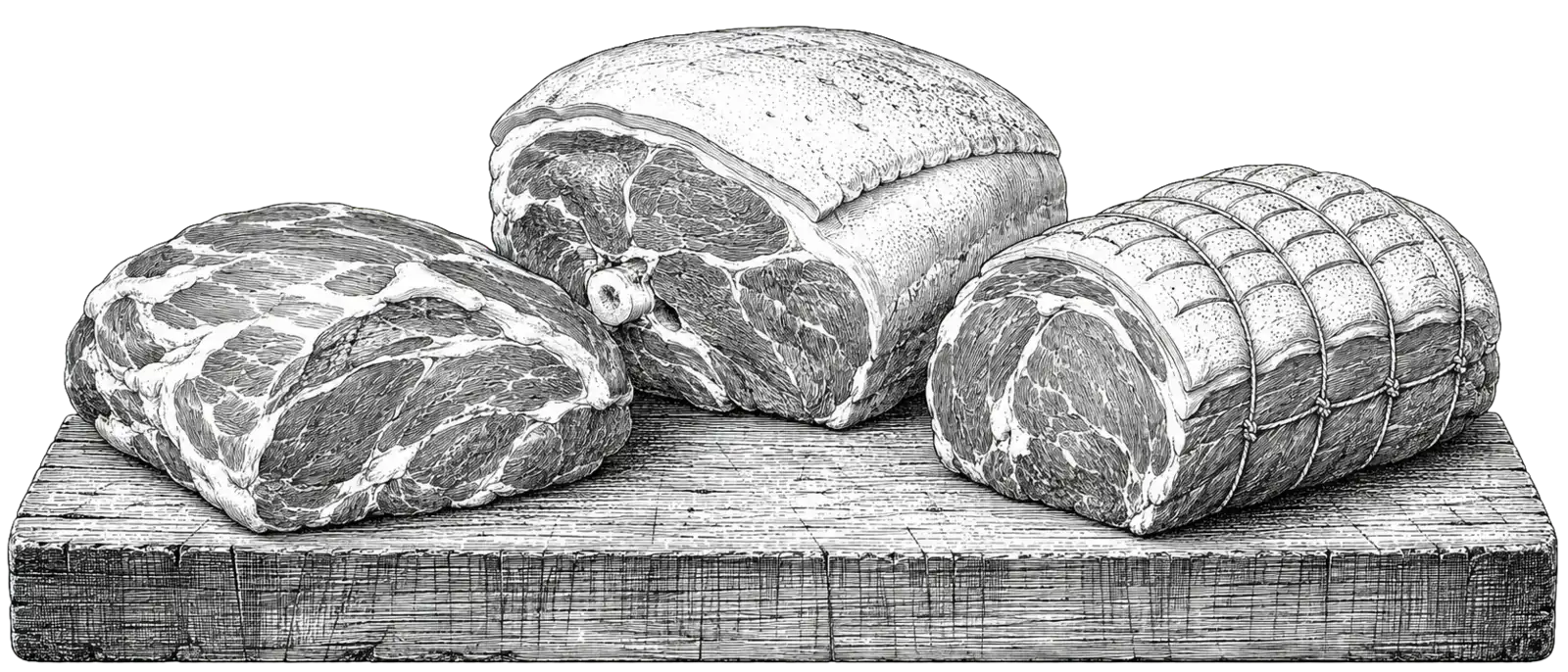
Pork collar, Boston butt and boneless pork shoulder all come from the front end of the pig, and all three are well suited to slow cooking. That similarity can make choosing between them confusing.
The important differences are in their shape, preparation, fat distribution and intended use. Pork collar is compact, richly marbled and unusually versatile. Boston butt is a substantial bone-in cut made for smoking and pulled pork. Boneless shoulder is the convenient, traditional roasting joint, particularly when you want neat slices and crackling.
Choose pork collar when you want a smaller, boneless joint with plenty of internal marbling. It can be roasted whole, braised, pulled or cut into thick steaks.
Choose Boston butt when pulled pork, long smoking or low-and-slow barbecue is the priority. Its bone, connective tissue and natural fat make it especially forgiving during a long cook.
Choose boneless pork shoulder when you want a familiar roasting joint that is easy to season, carve and serve. It is the best all-round choice for a traditional pork roast with crackling.
| Cut | Pork collar | Boston butt | Boneless pork shoulder |
|---|---|---|---|
| Where it comes from | Upper shoulder and neck end, close to the loin | Upper part of the shoulder | The broader shoulder, boned and rolled |
| Bone | Boneless | Normally bone-in | Boneless |
| Fat | Fine marbling throughout | Richly marbled with seams of fat and connective tissue | A mixture of lean meat, fat and connective tissue |
| Best for | Roasting, braising, steaks and smaller pulled-pork cooks | Smoking, barbecue and pulled pork | Traditional roasting, crackling and easy carving |
| Texture | Succulent, tender and relatively neat | Rich, soft and shreddable after a long cook | Tender and juicy, with a more varied grain |
| Typical Grid Iron sizes | 1.1kg or 2.2kg | 3kg half or 6kg whole | Available in a choice of joint sizes |
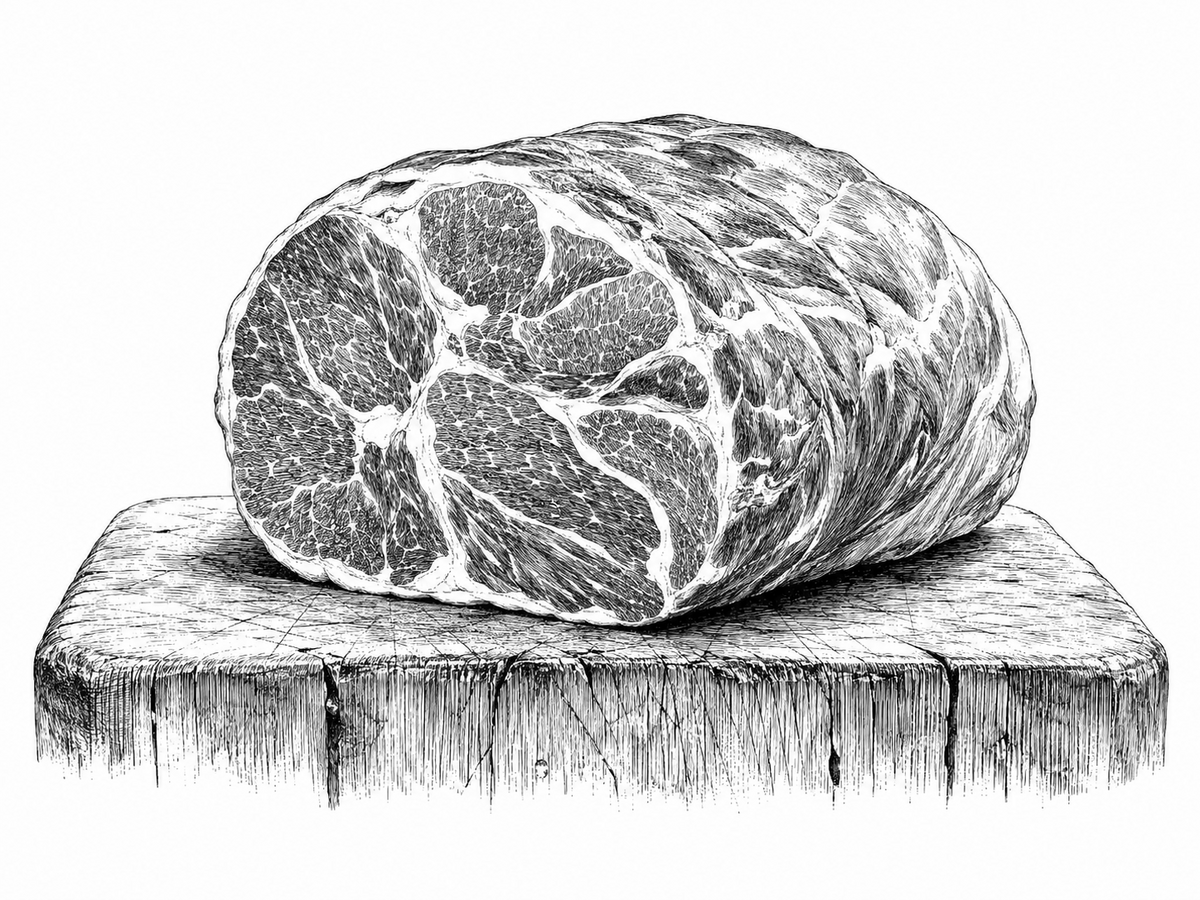 Pork collar comes from the upper shoulder and neck end of the pig, close to the loin. You may also see similar cuts described as pork neck or pork ribeye.
It has a compact shape and fine seams of intramuscular fat running through the meat. That marbling keeps it moist during roasting and gives it a rich flavour without the joint feeling as irregular as a conventional shoulder.
It is also the most versatile of the three cuts. A collar can be left whole for roasting or braising, cooked slowly for pulled pork, or sliced across the grain into thick steaks for grilling or barbecuing.
Pork collar is best for:
Shop the 1.1kg pork collar joint
Shop the 2.2kg whole pork collar
 Despite the name, Boston butt does not come from the back of the pig. It is a large cut from the upper shoulder. Butchery terminology varies, and there is some anatomical overlap between what different butchers call collar, neck and butt. In the Grid Iron range, the Boston butt is the larger, bone-in barbecue cut.
The combination of bone, fat and collagen makes it particularly suitable for long cooking. Given enough time, the connective tissue softens and the meat becomes tender enough to pull apart.
It is the natural choice for a smoker or offset barbecue because its size gives you time to build a dark, seasoned bark without drying the centre. It can also be cooked successfully in a conventional oven.
Boston butt is best for:
Shop the 6kg whole Boston butt
 Boneless pork shoulder is prepared by removing the bones and rolling the meat into an even roasting joint. It retains the flavour, fat and connective tissue that make shoulder rewarding to cook, but its regular shape makes it considerably easier to handle and carve.
It is the most familiar option for a traditional roast. The outside can be dried, salted and roasted to produce crackling, while the meat beneath cooks slowly until tender.
A boned and rolled shoulder is also useful when serving numbers matter. There is no bone to work around and very little uncertainty about the amount of usable meat on the table.
Boneless shoulder is best for:
Shop boned and rolled pork shoulder
Boston butt is the first choice for a large pulled-pork cook. Its size, bone and internal fat make it particularly well suited to spending many hours in a smoker or low oven.
Pork collar is an excellent alternative when cooking for fewer people. It has enough marbling to remain succulent and produces tender pulled meat, but its smaller size makes it easier to manage.
Boneless shoulder can also be pulled, although its rolled shape and outer skin make it particularly well suited to roasting. Choose it when you want the flexibility to serve some meat sliced and pull the softer sections.
Boneless shoulder is the easiest traditional roasting joint. It sits evenly in the roasting tin, provides a good surface for seasoning and is simple to carve.
Pork collar gives a slightly richer, more uniformly succulent roast. It is a particularly good choice when crackling is less important than juicy meat and clean slices.
Boston butt can be roasted, but its size and bone make it a more rustic proposition. It comes into its own when cooked beyond ordinary carving tenderness until the meat begins to pull away from the bone.
For a long smoker session, choose Boston butt. For a smaller low-and-slow cook, choose collar. For a roast cooked indirectly on a kettle barbecue, boneless shoulder is easy to manage and gives you the opportunity to crisp the skin at the end.
Pork collar is the only one of the three that also lends itself naturally to quicker grilling. Slice it into thick steaks and cook it over direct heat, moving it to a cooler part of the barbecue to finish gently.
Pork collar and boneless shoulder are both sold without bone, so almost all the weight is usable meat and fat. This makes them easier to portion and compare when planning a meal.
A Boston butt includes bone and may contain larger areas of fat and connective tissue. Those elements are part of what makes it perform so well during low-and-slow cooking, but the labelled weight should not be treated as an exact measure of the finished pulled meat.
There is no single best pork shoulder cut; the right answer depends on the meal.