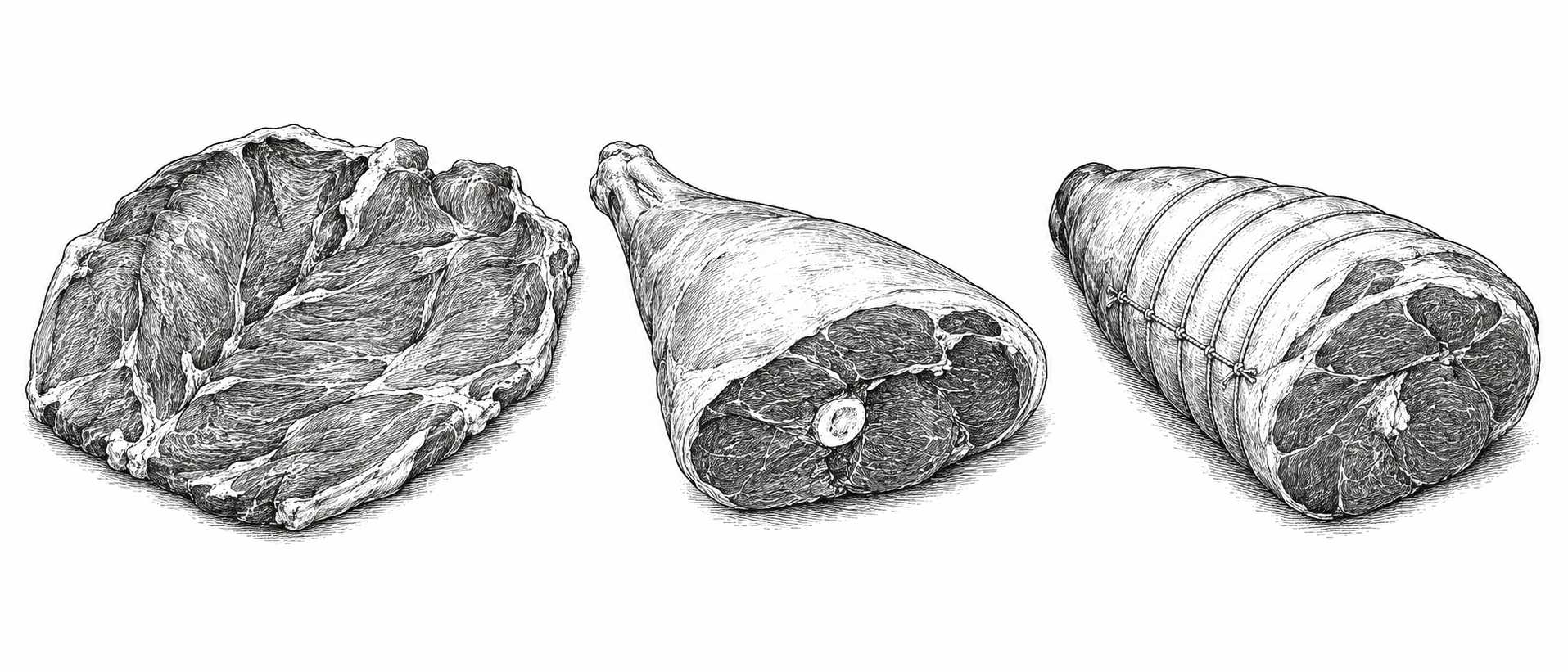
Bone-in, boned and rolled, or butterflied? Compare three ways of preparing leg of lamb and discover which is best for roasting, outdoor cooking, easy carving and faster cooking.
Bone-in, boned and rolled, and butterflied leg of lamb all begin with the same major cut, but the way the butcher prepares the leg changes how it cooks, how it carves and the type of meal it suits.
A bone-in leg is the traditional roasting centrepiece. A boned and rolled leg gives you a compact, evenly shaped joint that is particularly easy to carve. A butterflied leg is opened out into a broad, flatter piece of meat that cooks more quickly and is especially well suited to barbecuing, marinating and outdoor cooking.
Choose a bone-in leg when you want the appearance and character of a traditional roast, particularly for a Sunday lunch, Easter gathering or special occasion.
Choose a boned and rolled leg when easy carving, neat portions and a predictable roasting shape are most important.
Choose a butterflied leg when you want quicker cooking, plenty of browned surface and a joint that works particularly well on a barbecue, kamado or hot oven.
| Preparation | Bone-in leg | Boned & rolled leg | Butterflied leg |
|---|---|---|---|
| Shape | Traditional leg shape with the main bone retained | Boneless meat formed and tied into a compact roasting joint | Boneless leg opened out into a broad, flatter joint |
| Best for | Traditional roasting and impressive presentation | Easy carving, even roasting and neat portions | Barbecuing, faster roasting, marinades and outdoor cooking |
| Cooking speed | Usually the slowest of the three | More compact and relatively even | Usually the quickest because the meat is spread out |
| Browning | Good outer crust, with less overall surface exposed | Even browning around the outside of the rolled joint | The greatest exposed surface for crust, smoke and char |
| Carving | Requires carving around the bone | The simplest option for neat, uniform slices | Easy to portion, although the grain changes across the different muscles |
| Typical Grid Iron formats | 1.5kg, 2.5kg or a 3.5kg whole leg | Approx. 1.3kg half leg or 2–2.5kg whole leg | Approx. 1.3kg or 2–2.5kg |
A bone-in leg is the most traditional preparation. The leg retains its main internal bone and keeps the familiar shape associated with a classic roast lamb centrepiece.
The bone affects the shape of the joint and the way heat moves through the meat. The thicker sections cook more gradually, while the outside develops colour and the covering of fat renders during roasting.
A bone-in leg has a sense of occasion that the other preparations do not quite match. It arrives at the table looking substantial and is well suited to classic flavours such as rosemary, garlic, anchovy, thyme, mustard and lemon.
Carving takes a little more care because the knife must follow the contours of the bone. It also produces slightly less boneless meat for its labelled weight than a fully boned joint, although the bone and trimmings can be used to add character to gravy or stock.
A bone-in leg is best for:
Shop the 3.5kg whole bone-in leg
For a boned and rolled leg, the butcher removes the main bones before shaping the meat into a compact joint and securing it with butcher’s string or netting.
The result has a relatively consistent thickness and sits neatly in a roasting tin. This makes it straightforward to season, turn, check with a thermometer and carve into even slices.
Because there is no bone to work around, nearly all the purchased weight can be served. That makes a boned and rolled leg particularly useful when you are planning portions for a group.
The rolled shape gives less exposed surface than a butterflied leg, so it will not develop quite as much barbecue char. Its strength is convenience: it behaves like a familiar roasting joint and presents cleanly on the table.
It can also be untied and opened before cooking if you want to add a herb, garlic or breadcrumb stuffing, although it should then be rolled and secured again before roasting.
A boned and rolled leg is best for:
Shop the boned and rolled half leg
Shop the boned and rolled whole leg
A butterflied leg has the main bone removed before the meat is opened out into a broad, flatter joint. It is still made up of several different leg muscles, so it will not have a completely uniform thickness.
That variation is part of its appeal. The thinner sections develop deep browning and char, while the thicker areas can remain pink and juicy. It also gives the cook plenty of exposed surface for salt, spices, herbs and marinades.
The reduced thickness means it generally cooks more quickly than either a traditional bone-in leg or a compact rolled joint. It can be browned directly over hot coals or burners before being moved to a cooler area of a lidded barbecue to finish.
Butterflied lamb is also very useful when serving a relaxed gathering. It can be sliced and served hot, warm or at room temperature alongside salads, flatbreads, roasted vegetables and sauces.
A butterflied leg is best for:
Choose the bone-in leg if presentation and tradition matter most. It makes the most impressive centrepiece and suits the familiar ritual of bringing a whole roast to the table and carving it in front of your guests.
Choose the boned and rolled leg when you want a similarly traditional meal with less work at the carving stage. It provides the cleanest and most predictable slices.
A butterflied leg can still be roasted successfully, but it produces a different style of meal: quicker, more browned and slightly less formal.
The butterflied leg is the strongest all-round choice for barbecuing. Its flatter shape exposes more of the meat to smoke and direct heat, while the broad surface takes marinades and seasonings particularly well.
Set up the barbecue for two-zone cooking. Brown the meat over direct heat, then move it to the cooler side and close the lid to finish. Check the thickest section with a meat thermometer rather than relying only on time.
A bone-in leg also works well over indirect heat or on a rotisserie, but it needs more time and space. A boned and rolled leg can be roasted indirectly in a lidded barbecue in much the same way as it would be cooked in an oven.
The boned and rolled leg is the easiest to carve. Remove the string or netting after resting and cut across the joint into slices of the required thickness.
A butterflied leg is also simple to portion, but the direction of the grain changes because the leg contains several muscles. For the most tender result, separate the cooked joint into its natural sections where necessary and slice each section thinly across its own grain.
The bone-in leg requires more traditional carving technique. Work with the shape of the bone, removing large sections of meat before slicing them across the grain.
The butterflied leg generally cooks most quickly because it has been opened into a thinner, broader shape.
The exact cooking time will still depend on the weight of the joint, the thickness of its deepest section, the cooking temperature and your preferred degree of doneness. A thermometer inserted into the thickest part is more reliable than a fixed number of minutes.
The boned and rolled leg comes next. Its regular shape encourages relatively even cooking, but its centre remains thick. The bone-in leg normally needs the longest cooking time because of its size and shape.
All three can feed a gathering, but they suit different styles of service.
The larger butterflied joint is particularly useful when several other dishes are being served. It can be sliced onto a platter and guests can help themselves without the need for formal carving at the table.
Boned and rolled and butterflied legs contain no main leg bone, so almost all the purchased weight is usable meat and fat. This makes them straightforward to compare when estimating portions.
A bone-in leg includes the weight of the bone. That is not necessarily wasted: it contributes to the traditional presentation and can be used with the roasting juices and trimmings when making gravy or stock. However, it means that a bone-in joint and a boneless joint of the same labelled weight will not provide exactly the same amount of carved meat.
The butterflied leg is the best choice for marinades. Opening the meat increases the available surface area, allowing yoghurt, lemon, garlic, herbs, spices and oil-based marinades to coat more of the joint.
A boned and rolled leg can also be seasoned internally if it is untied and opened before cooking. A bone-in leg has less exposed surface, although small incisions can be used for garlic, rosemary, anchovy or other aromatic seasonings.
There is no single best preparation. Each one solves a different cooking problem.